
 Plagiarism Checker
 AI Detector
The Short Answer
When an AI detection tool flags a group assignment, the entire group shares responsibility for every word in the submission. That’s not just common sense — it’s how most university policies actually work. Turnitin’s AI Writing Report generates a single percentage for the entire document, with no individual attribution, meaning every student listed on the submission faces consequences for every flagged section.
But here’s the catch most students don’t understand: AI detectors cannot distinguish between group-authored text and AI-generated text. When multiple students merge different writing styles into one document, the resulting “edited-text effect” can actually trigger AI detection flags because detectors expect consistent stylistic patterns from a single author. This means innocent students can face serious consequences for work they genuinely helped produce collaboratively.
This is the responsibility problem at the heart of group work in the age of AI detection. Understanding it is the first step to protecting yourself and your group.
Why AI Detectors Can’t Tell Who Wrote What
The core tension is simple but powerful: AI detection tools evaluate a document as a single unit. They don’t know that Student A wrote the introduction, Student B drafted the analysis section, and Student C edited everything together. They see one document, one voice signature, and one score.
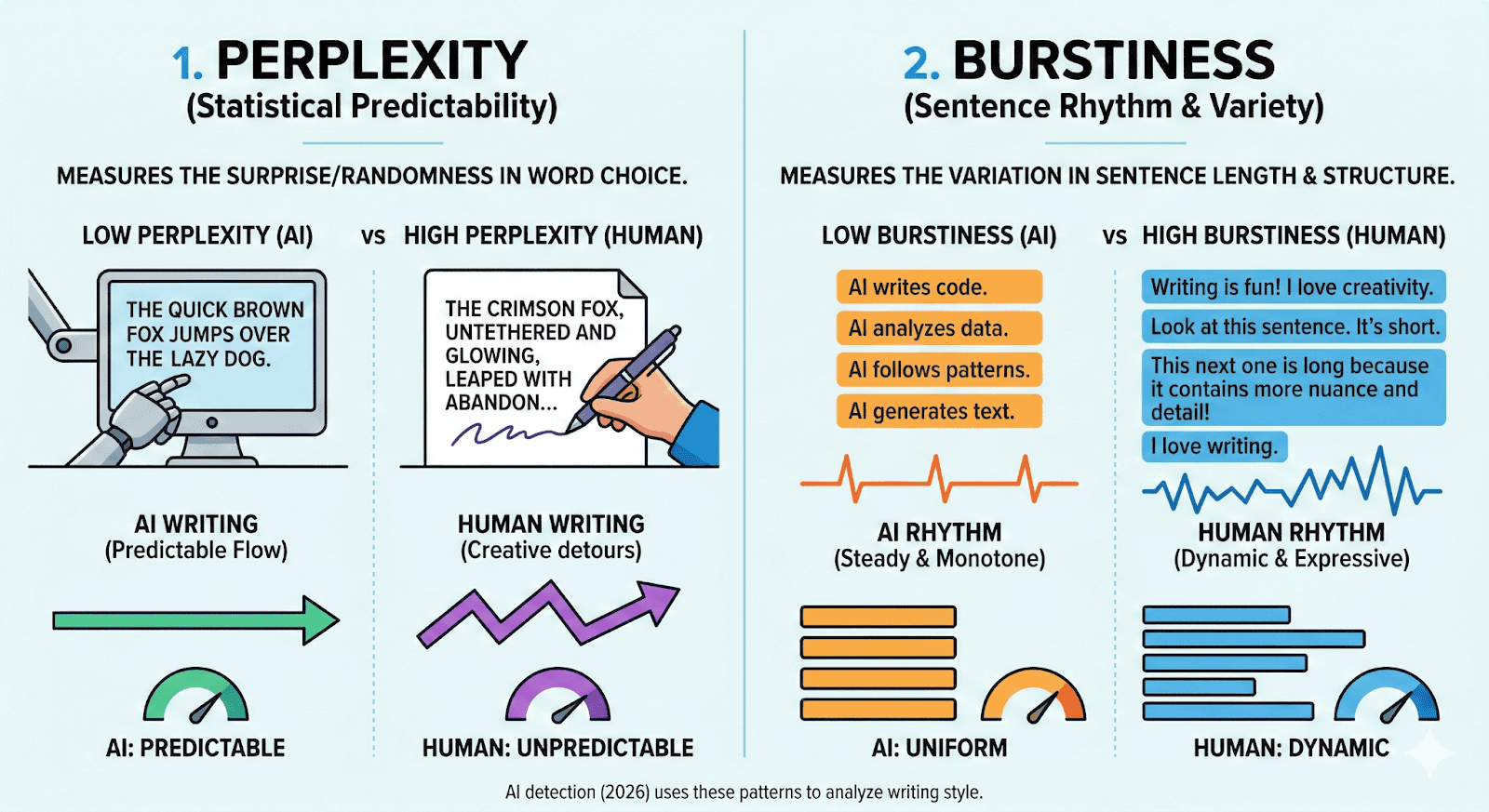
When you combine multiple human writing styles, the resulting document can trigger AI detection flags in unexpected ways. Detectors look for consistency — stable perplexity (how predictable the language is) and consistent burstiness (variation in sentence structure). When several writers contribute to a single document, the shifts between styles can create patterns that detectors interpret as artificially smoothed text.
The numbers tell the story. Studies document 10–50% false positive rates in co-authored documents simply because the editing process and merged writing styles create statistical signatures that detectors associate with AI output. This isn’t theoretical — it’s the “edited-text effect,” a well-documented phenomenon confirmed across multiple detection platforms.
The mathematical foundation is even more stark. A paper published in arXiv (2603.20254, Garland, 2026) provided a rigorous statistical proof showing that detection failures are mathematically unavoidable for diverse student populations, independent of detector quality arXiv 2603.20254. Even a “perfect” detector will produce false positives when some students’ writing overlaps with AI output distributions — and group assignments by definition involve diverse writers.
Collective Liability: How Universities Actually Assign Responsibility
The rules are consistent across institutions, even if the policies don’t spell out the group-specific details clearly.
How Turnitin Reports Work in Group Settings
Turnitin’s AI Writing Report generates a single AI percentage for the entire document. It doesn’t tell you which student wrote which section. It highlights sections that appear AI-like, but the score applies to the whole submission. Every student listed on the submission is held responsible for the entire AI score. This is documented by Turnitin’s official AI Writing Report guide.
How Universities Assign Blame
Most universities treat group submissions as collective responsibility. The University of Pretoria explicitly prohibits using shared editing platforms for individual work University of Pretoria AI policy. A student at the University of Pretoria was penalized for using Grammarly — a widely-used language tool they thought was permitted — without understanding it wasn’t allowed in that specific context. The university held the entire group accountable, even though they had no knowledge of the AI tool usage by their group mates.
The UK’s Office of the Higher Education Proctor (OIA) ombudsman has addressed this directly HEPI analysis of OIA cases. In July 2025, the OIA published four AI misconduct case summaries. The ombudsman upheld three of them — and all three involved international or ESL students. In one case, a student with autism was flagged twice by the same detection software for the exact same writing style, and the university was told to reconsider. In another, a student faced penalties for using Grammarly without understanding it wasn’t permitted for that assignment type.
The Structural Bias Problem
More than 61% of essays by non-native English speakers have been misclassified as AI-generated in peer-reviewed studies (Liang et al., 2023) structural bias evidence. This isn’t a detection quality issue — it’s a structural bias that affects international students disproportionately. When combined with the group work dynamic, ESL students can face compounded penalties: their non-native writing style combined with group collaboration creates the exact patterns detectors associate with AI output.
The BE WISE Framework for Student Groups
The BE WISE framework, originally developed for research ethics and published in Frontiers BE WISE framework, applies directly to student group work. Here’s what each letter means in practice:
B — Be transparent about AI use
Every group member must document all AI prompts used by any contributor and share the full prompt list with all group members. This isn’t optional — it’s the foundation of ethical group work. If one member used AI and the others didn’t know, the group can’t defend itself.
E — Evaluate every AI output
AI-generated content, even when used by only one group member, requires fact-checking by all contributors. When AI text is edited or integrated into group work, the editing process creates the “edited-text effect” that triggers detection flags. Each member should verify the factual accuracy of AI-assisted sections.
W — Write with intention
Don’t simply paste AI-generated text into your group document. Edit thoughtfully, add personal analysis, and make the writing distinctly yours. Intentional writing creates the stylistic consistency that detectors recognize as human authorship.
I — Individual accountability
Even though the submission is collective, each member should understand what they wrote, how they wrote it, and what AI tools were used. This means reading the full document together before submission and verifying everyone’s understanding of the content.
S — Save your process evidence
This is your strongest defense — see the checklist below.
E — Ethical equity
Ensure AI tools don’t disadvantage non-native English speakers in the group. ESL students are disproportionately affected by detection false positives, so the group should consider whether AI tools create unfair risk for certain members.
What You Can Do to Protect Your Group
Here’s a practical checklist for protecting your group from detection-related consequences:
1. Document every AI prompt used
Keep a running list of all AI prompts used by any group member. Share it with everyone before submission. If someone used AI and didn’t tell you, you can’t defend the group.
2. Save version history
Use Google Docs, OneDrive, or any platform that generates version history. This shows who edited what and when. If your university prohibits shared editing platforms for individual work (the University of Pretoria explicitly forbids this), be aware of the boundary and document your work accordingly.
3. Maintain draft trails
Save early drafts, not just final versions. Show the evolution from your ideas to polished text. This demonstrates your actual writing process.
4. Verify all AI-assisted content
If any member used AI, have every other member read and fact-check the AI-generated sections. This creates a chain of human engagement that detectors recognize as authentic writing.
5. Write your own sections
Contribute substantive content rather than just editing. The more individual voices present, the clearer the human authorship signal becomes.
6. Know your university’s policy
Read the AI policy for your specific institution. Policies vary significantly — Oxford states that “you are fully responsible for the accuracy, originality, and quality of work you submit” Oxford student AI guidance, but group-specific guidance varies. Don’t assume one policy applies universally.
When to Choose Collaboration vs Individual Work
Not all group assignments carry the same risk. Here’s a practical framework for deciding when collaboration makes sense and when individual work is safer:
Choose group work when:
- The assignment requires diverse perspectives (case studies, literature reviews, group projects)
- Your university has clear group submission policies
- You have strong version history tracking (Google Docs, shared notebooks)
- All members are willing to document AI use transparently
Choose individual work when:
- Detection risk is high (your instructor is actively using AI detection)
- You don’t have reliable version history
- Some group members are reluctant to share AI usage
- ESL students are in the group (higher false positive risk)
The Australian regulator TEQSA recommends a “two-lane approach” to assessment design TEQSA AI detection guide. — one lane for detecting AI plagiarism and one for verifying genuine student work. If your assignment design doesn’t support verification, the risk of false positives is genuinely high.
Summary + Next Steps
The responsibility question in group assignments isn’t theoretical — it’s happening right now. The UK’s OIA ombudsman has already ruled on AI detection cases involving group work, mathematical proofs show detection failures are unavoidable for diverse populations, and universities are updating policies faster than students can adapt.
What this means for you:
- Know that AI detectors can’t attribute authorship — they evaluate the whole document, not individual sections
- Understand that collective liability means everyone shares responsibility for every word
- Protect yourself with process evidence: version history, draft trails, and documented AI usage
- Apply the BE WISE framework to your group’s workflow
- Know when collaboration is safe and when individual work is the better choice
The tools are imperfect. The policies are evolving. But the defense is straightforward: document your process, be transparent about AI use, and know your rights under your university’s policies. When a detection tool flags your group work, that documentation is what separates innocence from guilt.
Want to verify your own work before submission? Run a quick scan with our AI detection service to catch potential issues before they become problems.
This article covers responsibility attribution in group assignments under AI detection. For a companion guide on compliance procedures, transparency logs, and version tracking, see our AI Detection in Group Assignments — Compliance Guide.