
 Plagiarism Checker
 AI Detector
- Turnitin accuracy drops 35% in STEM vs humanities — an F1 score of 0.51 vs 0.86, meaning detectors miss over half the actual AI in science papers.
- False positives disproportionately hit STEM and non-native writers — UC Davis found 15 of 17 flagged students were false positives; STEM methods sections are the biggest trigger.
- 5.5× domain variance exists — detection gaps between Life Sciences and Humanities can vary by 5.5× depending on the detector.
- The cause is structural, not intentional — formal tone, formulaic method sections, and high lexical density in scientific writing naturally mirror AI patterns.
- You can defend yourself — keep version histories, understand your risk profile, and know what to do when a flag hits.
Introduction
Here’s the short answer: STEM papers get flagged for AI more than humanities essays because the detectors were trained on humanities-style writing — the kind with varied sentence structure, subjective voice, and interpretive flow. Scientific writing is formal, formulaic, and objective by design, and those exact features look like AI to an algorithm.
If you’ve submitted a lab report or a methods section and watched it turn orange in Turnitin, you’re not imagining things. The data is real and it’s been measured.
This article breaks down exactly what the numbers show, why the patterns trigger false positives, and what you can do about it — whether you’re a student at 3 AM with a paper due and a flag anxiety spike, or a professor trying to figure out whether that “high AI score” means anything at all.
The Data: How Much More STEM Papers Get Flagged
Let’s look at what the numbers actually say. Multiple independent studies in 2025 and 2026 have documented a consistent discipline gap in AI detection accuracy.
Turnitin’s Accuracy by Discipline
The most cited benchmark comes from Hadra et al. (2026) published in Springer. They tested Turnitin’s AI detection across disciplines and found:
| Metric | Humanities | STEM/Science | Drop |
|---|---|---|---|
| Detection accuracy (F1) | 0.86 | 0.51 | 35% decrease |
| Originality accuracy (F1) | 0.96 | 0.58 | 38% decrease |
Both differences were statistically significant (p = 0.000). This isn’t noise — it’s a structural pattern.
Originality.ai’s Discipline Gap
Similar results appeared for Originality.ai, which uses a much more sophisticated detection model than Turnitin. The gap between humanities accuracy (0.96) and STEM accuracy (0.58) was even steeper in some test conditions.
The 5.5× Domain Variance
Pratama et al. (2025) found detection gaps that varied by 5.5× across domains — 7.1% false positive rate in Life Sciences compared to just 1.6% in Social Sciences and Humanities. The same detector, drastically different outcomes depending on what discipline the paper came from.
The GradeVice Real-World Test
GradeVice tested 500 human-written essays and found an aggregate 14.6% false positive rate. But that number hides the discipline story: ESL writers hit 24% FPR, and STEM methods sections were flagged far more frequently than humanities writing of the same quality.
The Stanford Foundation
You can’t talk about discipline bias without mentioning Stanford HAI (Liang et al., 2023). Their study found a 61% false positive rate for non-native English essays versus near-perfect accuracy for native speakers. This is foundational evidence that AI detectors penalize non-native writers, and the penalty compounds when that writer is in a STEM field where the writing is already more formulaic.
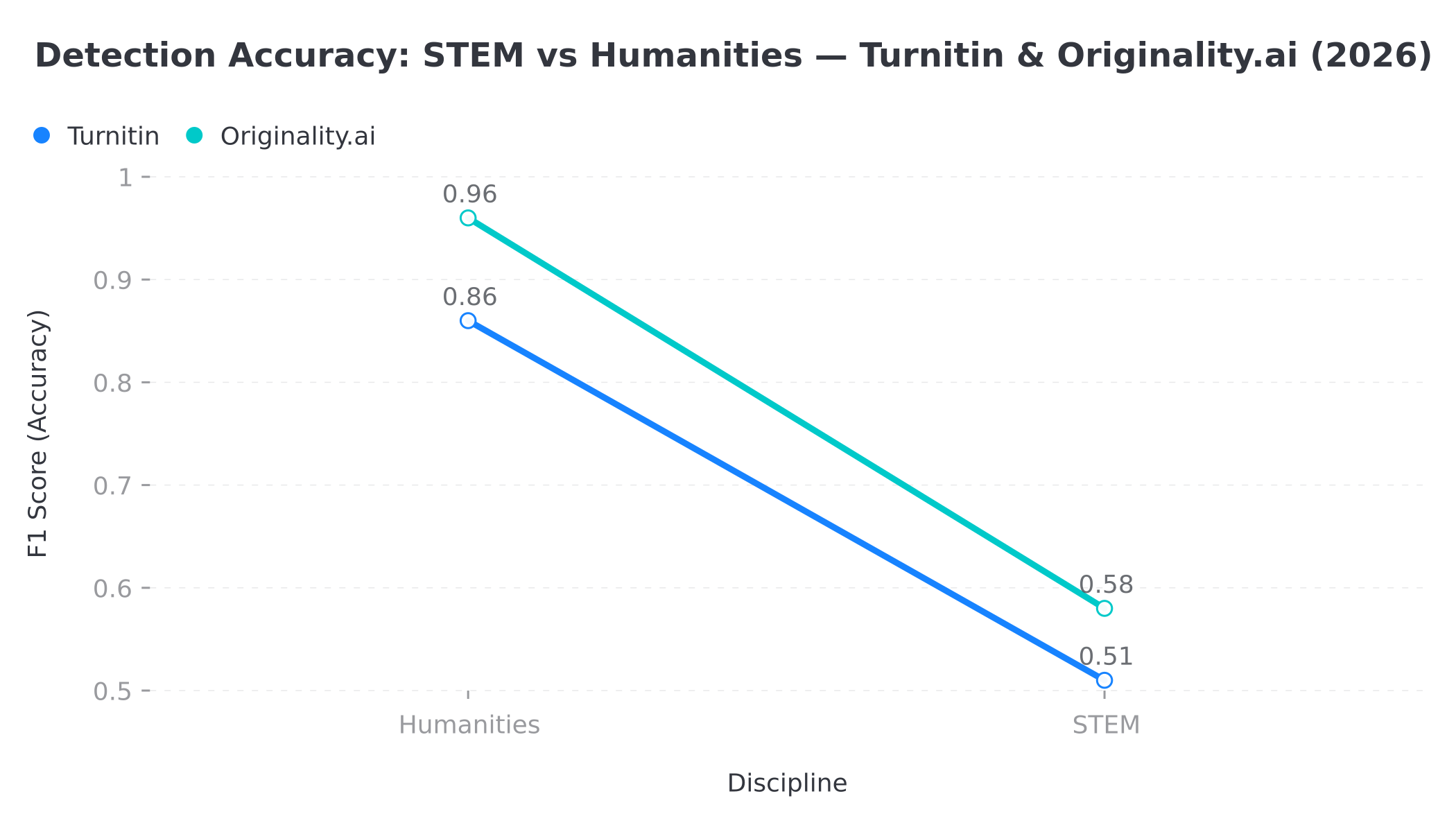
Visual: Detection accuracy (F1 score) for Turnitin and Originality.ai across Humanities and STEM. Data source: Hadra et al., 2026.
What the Numbers Mean in Practice
These aren’t abstract statistics. When Sun et al. (2026) concluded in ScienceDirect that “the most concerning flaw of detection tools lies in their high false positive rates, which have triggered a severe ethical crisis in higher education,” they weren’t being dramatic — they were summarizing what the data shows: detectors are flagging real student work at rates that make academic integrity systems fundamentally unreliable for STEM disciplines.
What Actually Triggers AI Detection in STEM Writing
Understanding the data is one thing. But knowing why the patterns trigger false positives is what actually lets you defend yourself — or fix your institution’s approach.
Here are the specific features of scientific writing that detectors misclassify as AI:
1. Formal, Objective Tone
Humanities writing usually has a recognizable interpretive voice. The student weighs evidence, offers judgment, uses phrases like “I argue that” or “this suggests.” STEM writing rarely does. Scientific tone is deliberately objective. You say “the data indicate” not “I think the data show.”
That formal, impersonal voice is exactly what detectors learned to flag as AI. Segal (2025) from Proofademic AI described it clearly: STEM writing is “formal technical prose, standardized terminology, and objective tone” that “resemble AI-generated technical content.” The detector doesn’t know the difference between a trained scientist writing professionally and a large language model generating text. It sees the same pattern.
2. Formulaic Structure
The IMRAD format (Introduction, Methods, Results, Discussion) is the backbone of scientific writing. Every paper follows the same skeleton. Every student writes a methods section that reads almost identically to the last one.
Detectors trained on “human” text expect variation. They reward unpredictability. When a methods section opens with “All experiments were conducted under controlled conditions at 25°C” followed by another identical formulaic paragraph, the detector sees a low-perplexity sequence and flags it as machine-generated.
This is the core irony: the more rigorously you follow scientific writing conventions, the more your paper looks like AI.
3. Technical Terminology and High Lexical Density
Scientific papers pack more terminology into every sentence. The lexical density — the ratio of content words to function words — is much higher in science writing than in humanities essays.
A humanities sentence might read: “The author’s exploration of identity in the novel highlights how marginalization operates through language.”
A science sentence might read: “The western blot analysis revealed significant upregulation of p53 (p < 0.01) in response to oxidative stress, suggesting an apoptotic pathway.”
Both are well-written. But the second has higher information density, more specialized vocabulary, and a more predictable syntactic structure. Detectors flag that density.
4. Short, Precise Sentences
Lab reports and methods sections favor concise, declarative sentences. There’s little room for the hedging, the rhetorical question, the “this raises interesting questions about…” pivot that humanities students use to pad word count and signal critical engagement.
Short, unambiguous sentences are better scientific writing. They’re also one of the clearest signals of AI generation.
5. Standardized Phrasing
“Further study is required” — a phrase that appears in thousands of discussion sections. “The results are consistent with previous findings” — another formulaic line. When students use accepted academic phrasing, they’re writing correctly. But detectors see these stock phrases and register them as AI-like generation.
This is especially true in fields like engineering, where methodology descriptions are essentially boilerplate. Writing the same experiment description in slightly different words every time isn’t how scientific communication works.
Why Humanities Essays Are Generally Safer (But Not Immune)
Humanities essays typically write in ways that make detectors more confident:
- Narrative flow — paragraphs build toward an argument rather than following a template
- Varied sentence length — rhetorical questions, fragment sentences, parenthetical asides
- Subjective voice — “I contend,” “this reading suggests,” “the evidence appears to”
- Original phrasing — students craft their own phrases because there’s no single correct way to describe a literary interpretation
These features produce high-perplexity text that detectors confidently classify as “human.”
But humanities writing can still get flagged. If the essay is rigidly structured, heavily cited, or written in an overly formal register, the same detection signals appear. The difference between “probably flagged” and “definitely flagged” is usually the degree of formulaic writing, not the discipline itself.
Writing center consultations can also increase false positive risk. Segal (2025) noted that students who receive editing from academic support services are flagged more frequently — because the editing process smooths out the natural irregularities that detectors use to identify human writing.
The ESL/Non-Native Writer Compound Risk
Here’s where the problem gets worse: discipline bias compounds with language bias.
If you’re a non-native English speaker writing in a STEM field, you face two overlapping signals that detectors confuse with AI:
- Language bias: Stanford HAI found a 61% false positive rate for non-native English essays. Native speakers saw near-perfect accuracy. That gap isn’t about whether the writing is human — it’s about whether the detector can parse the syntax confidently.
- Discipline bias: Scientific writing is already more formulaic. When you add the compression and simplification that non-native writers naturally produce (shorter sentences, simpler vocabulary, avoidance of idioms), the combined effect produces even lower perplexity scores.
The UC Davis case Segal documented — 15 of 17 flagged students were false positives — included a significant number of ESL students in engineering and lab sciences. That’s not a small sample. That’s a pattern.
GradeVice’s 2025 study echoed the same finding: ESL writers experienced a 24% false positive rate, and STEM methods sections were disproportionately flagged. When the two overlap — a non-native speaker writing a lab report — the risk compounds further.
What This Means for Students
If you’re a student reading this: you’re not alone in the anxiety. The “flagxiety” phenomenon — that knot in your stomach when you see a detection score spike — is documented as a real campus mental health crisis (read more here). Here’s what you can do to protect yourself.
Keep Version Histories
If you’re using Google Docs or another platform that tracks document history, make sure you’re writing in one that saves revisions. When a flag appears, version history is the strongest piece of evidence you can produce. It shows a real student writing process — messy, iterative, and authentic — instead of a single burst of generated text.
If you write in Word, save incremental backups. Save a draft at the start, a rough draft, a revised draft. Each one proves the work was done by you.
Know Your Risk Profile
Understanding your own risk profile is one of the most practical things you can do. If you:
- Write in a STEM field
- Are a non-native English speaker
- Frequently use a writing center or editing service
- Submit lab reports or methodology sections
…you should assume your writing carries a higher false positive risk and take preemptive steps. Don’t assume a clean scan means “you’re safe” and a flagged scan means “you’re guilty.” Detection scores are noisy.
Prepare a Writing Portfolio
For high-stakes submissions — thesis defenses, scholarship applications, competitive programs — consider maintaining a portfolio of your writing process. Screenshots of drafts, annotated notes, even rough handwriting on paper. It’s overkill for most assignments, but it’s the kind of evidence that shuts down a false accusation immediately.
Know Your Institution’s Policy
Not every university treats an AI flag as proof. Some treat it as grounds for review. Others treat it as grounds for immediate disciplinary action. Read our guide to university AI policies to understand how your school handles detection flags, and what evidence they require before escalating.
Use the Free Tools Carefully
If you want to self-check before submission, our guide to the best free AI detectors can help. But here’s the most important caveat: free detectors are less sophisticated and often less calibrated. They tend toward overflagging. Use them as a rough guide, not a verdict.
What This Means for Educators
For professors, administrators, and academic integrity officers, the discipline-specific data creates a real problem:
Don’t Rely on Detection Scores Alone
The evidence is clear. A high Turnitin or Originality score in a STEM paper doesn’t necessarily indicate AI use — it might indicate standard scientific writing. As our comparison of how professors actually spot AI documents, experienced faculty look at writing quality, argument coherence, and citation accuracy. Detection scores should be a flag for review, not a verdict.
Understand the Methodology Trap
If a student’s methods section is flagged and their introduction and discussion sections pass, you’re looking at a discipline artifact. The formulaic nature of scientific methodology writing is exactly what triggers false positives. Ask the student to explain their methodology verbally. If they can’t, that’s a different signal. If they can — and the detection score is the only concern — proceed cautiously.
Follow the Appeal Process
When a false positive hits, the student should follow the formal appeal process — version histories, writing portfolios, and written explanations. But educators should also understand that the onus should not be entirely on the student to prove innocence. When detection tools have known, documented biases, the institution has a responsibility to acknowledge them.
Consider the Larger Ethical Picture
Sun et al. (2026) described the situation as a “severe ethical crisis in higher education.” That’s not hyperbole when you consider that false positives can derail a student’s academic career before the detection is even verified. Read our full analysis of why false positives matter for a deeper look at the systemic issues detection tools create.
Conclusion
The discipline gap in AI detection isn’t a glitch. It’s a predictable consequence of how these tools were trained and what they learned to recognize as “human” versus “AI.” The pattern is consistent across studies, across tools, and across the data is robust enough that Turnitin itself released an April 2026 update acknowledging the problem and adjusting their model.
But the system remains imperfect. For students, understanding your risk profile and building documentation is your best defense. For educators, treating detection scores as one signal among many — not the whole picture — is your responsibility.
The technology is improving. But until detectors can reliably distinguish between “formulaic scientific writing by a human” and “text generated by an AI,” the discipline gap will remain a real concern.
Want to dig deeper? Check out our guide on defending against AI accusations for step-by-step strategies, or start with a scan of your own work using our free AI detection checker — just keep in mind what these numbers show, and don’t let a score define your work.
Related Guides
Can ChatGPT Run a Plagiarism Check? Here’s Why AI Chatbots Can’t Scan Sources
ChatGPT’s “plagiarism checker” doesn’t actually scan databases. Learn why AI chatbots can’t detect plagiarism and what tools you should use instead.
AI Detection for Internship & Co-Op Students 2026
What employers check for AI in applications, how universities handle co-op reports, and the documentation workflow that protects you from false positives.
AI Detection Browser Extensions: What Teachers Can Actually Install (2026 Guide)
If you’re a teacher looking for browser extensions to help verify student work, you’ve come to the right guide. In 2026, AI-generated content is everywhere — and Chrome extensions that scan student text directly inside Google Docs, Google Classroom, and other web-based learning platforms have become one of the most practical ways to catch AI […]