
 Plagiarism Checker
 AI Detector
Key Takeaways
- AI detectors don’t read your writing — they measure statistical predictability. No score is proof of misconduct, and a flagged thesis doesn’t prove you used AI.
- Graduate-level writing is uniquely vulnerable to false positives. IMRaD-formatted thesis chapters, standardized methods sections, and formulaic abstracts all trigger detectors — even when you wrote every word.
- The best defense is process evidence. Draft histories, commit logs, and revision timestamps matter far more than any single detection score.
If you’ve spent years on your thesis and submitted it, only to get a message asking you to meet about a “flag” — I want you to take a breath. You’re not alone. Here’s what you need to know before that meeting.
AI Detection for Graduate Students: PhD Thesis and Dissertation Verification in 2026
You’ve spent years on your thesis. You’ve run experiments, collected data, written chapter after chapter, and finally submitted your dissertation. Two weeks later, your supervisor asks you in for a meeting. There’s a “flag” on your document.
Your heart stops.
Here’s what most people don’t tell you: AI detection is not a truth machine. It’s a probability signal. And at the graduate level, where your formal, polished academic writing is also exactly what detectors flag, you’re operating in a zone where even well-written work can get caught in the net.
This guide covers what AI detection actually means for your thesis, how universities verify authorship, what tools are used, and most importantly — how you protect yourself from false flags. No single detection score should ever be used as proof of misconduct. Process evidence is your strongest defense.
What AI Detection Actually Means for Your Thesis
First, let’s address the elephant in the room: AI detectors don’t read or understand your writing. They measure mathematical patterns in your text and return a probability score. The score is a signal, not a sentence. And here’s the problem: human writing naturally shares some of those patterns with AI-generated text.
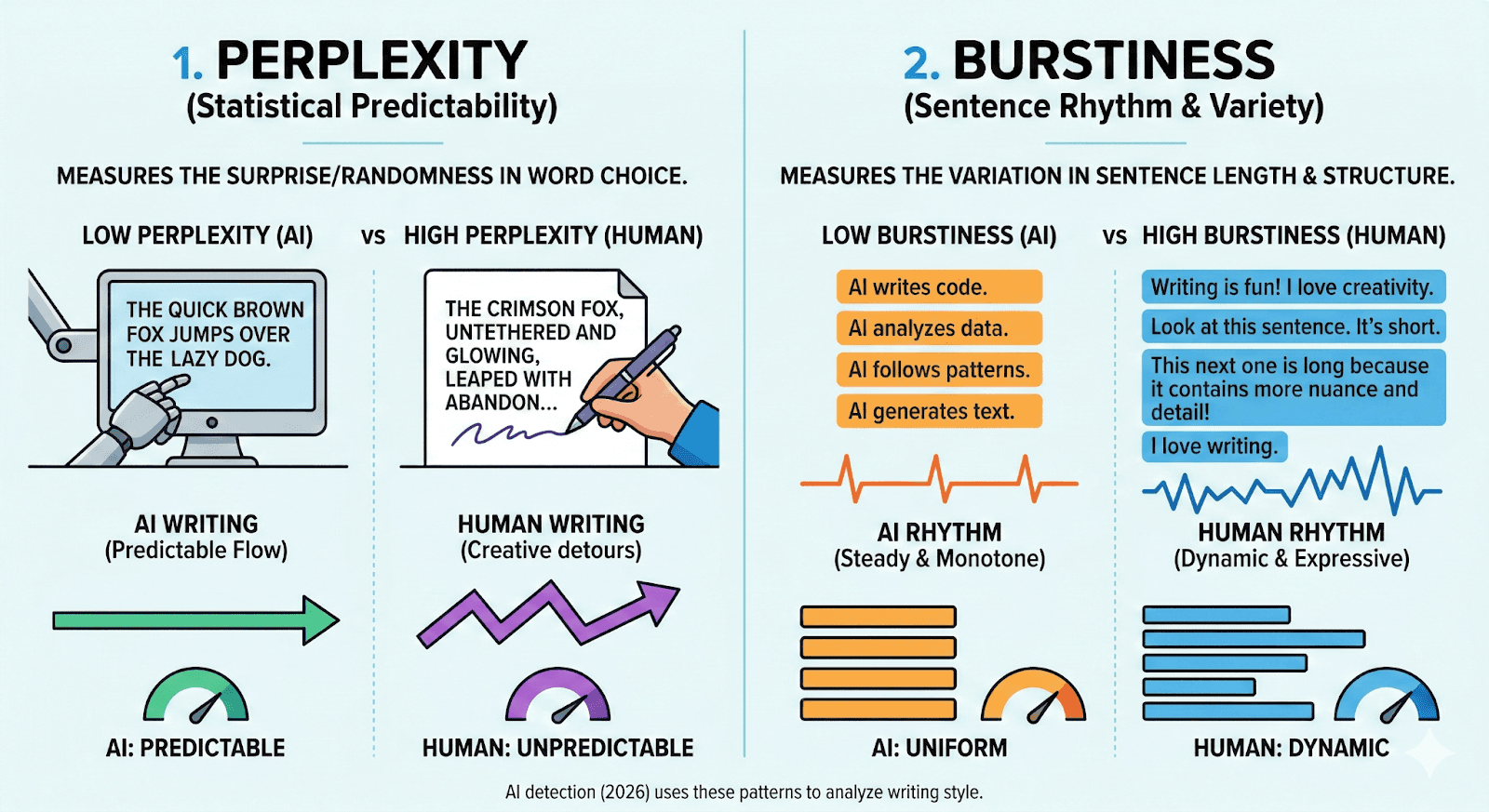
AI detectors analyze two primary signals:
- Perplexity — How predictable each word is given the words before it. AI text tends toward low perplexity (high predictability). But formal academic writing, technical documentation, and even ESL writing naturally produce low perplexity too. A research paper with standardized terminology like “mitochondrial DNA replication” repeated throughout will have low perplexity — not because it’s AI-generated, but because it’s precise and structured.
- Burstiness — Variation in sentence length and structure. Humans write with rhythm — short punchy sentences followed by longer explanations. AI tends toward uniformity. But students who follow strict academic conventions, lab report writers, and anyone using discipline-specific writing standards produce text with reduced burstiness.
This isn’t theoretical. A 2026 Stanford follow-up by Liang et al. found a 61.3% false-positive rate on TOEFL essays by Chinese students, compared with just 5.1% for US students in the same setup. Graduate students are disproportionately represented in this population.
The takeaway? A high detection score doesn’t mean “this is AI.” It means “this text has statistical patterns I associate with machine writing.” And well-written academic prose has exactly those patterns.
The Thesis Detection Paradox: The better your writing is, the higher the risk of a false positive — because polished, conventional academic work mimics AI statistical patterns.
The Graduate-Level Detection Problem
Here’s something counterintuitive: writing well can trigger a false positive.
Most AI detection tools were trained on undergraduate essays — messy, varied, personal writing. But a PhD thesis is not an undergraduate essay. It follows strict conventions: IMRaD structure (Introduction, Methods, Results, Discussion), standardized protocol descriptions, controlled vocabulary, and formal transitions.
And this is exactly what detectors flag.
Why Thesis Writing Triggers Flags
A 2026 analysis by Editage explains the domain-shift problem clearly:
- IMRaD structure enforces low-variation prose — Methods sections are deliberately uniform, reporting guidelines like CONSORT and PRISMA standardize sentence patterns across thousands of papers, and ethics statements are near-identical across submissions.
- Disciplinary vocabulary limits lexical diversity — A biology paper discussing “mitochondrial DNA replication” 15 times is using precision, not plagiarism. Detectors interpret limited vocabulary as an AI signature.
- Structured abstracts compress formulaic content — An abstract on its own is usually too short to score meaningfully, so standalone abstract checks tell you almost nothing.
- Multi-author drafting produces stylistic discrepancies — Some tools read transitions between co-author sections as AI-generated text.
Research from Van Vlasselaer et al. (2026) comparing four detection tools across four types of academic papers found that performance degrades steeply once text is edited or humanized — which is exactly what happens when a graduate student revises their thesis.
The Non-Native English Factor
The false-positive problem is not evenly distributed. A 2026 follow-up from CASRAI/NISO confirms the Stanford findings: non-native English speakers face the highest false-positive risk. Graduate students are disproportionately represented in this population because international students make up a large share of PhD programs worldwide.
When human-written text in another language is translated into English, mean detection accuracy falls by roughly 20%. This places researchers who draft in their first language and translate at direct risk.
Career Asymmetry
The same flag carries very different consequences depending on your career stage:
- A grad student has no or minimal publication record to establish an independent writing voice.
- Visa status, funding, and program progression can all hinge on a single publication.
- Power imbalances make it hard to push back against a supervisor or examiner who trusts the score.
This asymmetry is why understanding detection tools matters so much for graduate students. You’re not just defending your thesis — you’re defending your career.
For a deeper look at why detection scores are so unreliable, read our guide on AI detection accuracy and false positives, which breaks down why even the best tools misflag 1-12% of human writing.
Tools Universities Use for Thesis Verification
Universities don’t use a single tool. They deploy layered verification workflows, and understanding what’s used is the first step in protecting yourself.
The Tools You’ll Encounter
| Tool | Typical Use in Higher Ed | Output | Reliability Notes |
|---|---|---|---|
| Turnitin | Common (embedded in LMS) | % indicator + highlights | Not always accurate; not sole basis for action |
| GPTZero | Common (varies by region) | Probability/score + highlights | Robustness varies by text type and edits |
| Copyleaks | Common (some institutions) | Score + highlights | 100+ languages; robustness varies by domain |
| Originality.ai | Sometimes | Score + paragraph analysis | Robustness varies by model/edits |
Turnitin is the most common tool you’ll encounter because it’s embedded in many institutional submission workflows. Turnitin’s own guidance is explicit: its AI writing detection “may not always be accurate” and “should not be used as the sole basis for adverse actions against a student.” A similar caution appears in university guidance — for example, the University of Twente advises staff not to treat Turnitin results as proof without further investigation.
A 2026 peer-reviewed evaluation by Van Vlasselaer et al. compared detection accuracy across academic papers and found that even top tools detect 90%+ of raw AI but only 3-8% of edited or humanized text.
The RAID Benchmark Findings
The RAID benchmark (ACL 2024) found that detectors can perform well on familiar distributions, yet become unreliable under adversarial attacks, changes in sampling strategy, and unseen models or domains. This is the practical reason why your professor should not treat a single score as decisive.
Turnitin’s accuracy data on unedited AI ranges from 88% to 92% with a 1% false-positive threshold — impressive in lab conditions, but those conditions rarely match real-world thesis submissions where text has been edited, translated, or co-authored.
Why “Accuracy” Claims Vary So Much
If you see headline accuracy numbers online, treat them as conditional. Peer-reviewed evaluation work shows why:
- A benchmark built on older model output scores higher than one on newer models.
- Default single-shot prompts produce flatter text than iterative, edited drafting.
- Longer samples are easier to classify.
- A test set that is half AI-generated bears no resemblance to a real submission pool.
Weber-Wulff et al. (2023) found that most tools are deliberately biased toward classifying text as human-written. That choice protects authors, and it also means roughly 20% of unmodified AI-generated documents in their test set were misattributed to humans.
How Professors and Doctoral Committees Actually Evaluate AI in Your Thesis
You might expect a detection score to be the final verdict. But it isn’t. In practice, professors rarely rely on a single signal to decide whether AI was used. Most use a combination of automated checks, manual judgment, and process-based verification.
The 4-Step Multi-Tool Verification Workflow
Leading institutions deploy a layered verification workflow that treats detection scores as starting points, not endpoints:
- Primary LMS scan — Turnitin or institutional detector runs on the submitted document.
- Secondary cross-verification — Independent tools (GPTZero, Copyleaks) are used to compare results across tools. When scores disagree sharply, the result is unstable.
- Process artifact audit — Version history, drafting timestamps, Git commits, and citation records are reviewed. This is where your draft history matters most.
- Human-led dialogue — A structured conversation with the student about their work. Can they explain their methodology? Justify their sources? Describe how their argument developed?
The thesify.ai professor methodology breaks this down comprehensively. A 2025 study by Fiedler (International Journal for Educational Integrity) found that people distinguish AI-generated text from human writing only slightly better than chance — especially as model quality improves.
Manual Red Flags Professors Look For
When professors suspect AI use, they often start with the simplest question: Does this sound like you?
That manual review typically includes checks like:
- Sudden shifts in tone, formality, or vocabulary compared to your earlier work
- Unusual structure or “too smooth” transitions that don’t match your typical drafting habits
- Generic arguments that stay high-level and avoid clear commitments
- Citations that don’t exist, don’t support the claim, or are inconsistently formatted
- Missing process evidence, such as no outline, no drafts, or a document that appears to be written in a single session
- Suspicious process patterns, including unusually fast turnaround or minimal revision history
If something feels off, professors may compare your submission to earlier assignments, in-class writing, or past drafts. They may also ask you to explain key choices orally.
Thesis Defense as the Ultimate Detection Defense
A dissertation defense has an advantage a journal query lacks: you are in the room, and you can demonstrate command of your own work directly.
Smart-Edu’s practical guide for graduate students recommends:
- Be ready to explain any passage in your own words, including why particular phrasing was chosen.
- Bring the drafting record to the meeting rather than promising to send it afterward.
- Ask for the specific allegation in writing before the meeting, so you can prepare against a defined claim.
- Check your institution’s procedure for whether you may bring a supporter or union representative.
Oral defense panels increasingly use comprehension verification (not detector scores) as the primary authorship signal. A candidate who can explain their methodology and defend their choices survives any false flag. This is why the oral defense remains the ultimate detection defense.
University AI Policies for Graduate Students
Policy has shifted dramatically in 2026. Universities are moving from emergency prohibition to structured regulation, and graduate-level requirements are tightening.
The Three-Phase Policy Evolution
Plagiarism-checker-online.net tracks the three-phase evolution of university AI policy:
- Emergency prohibition (2023-2024): blanket bans on AI, minimal guidance.
- Differentiation/disclosure (2024-2025): distinction between permitted and prohibited use, with mandatory disclosure.
- Integration/course-level autonomy (2025-2026): departments set their own rules, with graduate programs applying stricter limits than undergraduate coursework.
Graduate-Level Tightening
Writebros.ai’s 25-point survey of university policy shifts identified “stricter AI limitations for graduate theses and capstone research” as a 2026 trend. Graduate schools generally inherit detection from undergraduate assessment infrastructure, which means thresholds and procedures designed for coursework get applied to a dissertation.
Our guide to university AI policies explained covers how to read syllabuses and stay compliant across different courses — essential reading for any graduate student navigating this landscape.
What This Means for Your Thesis
Most universities treat detection scores as review triggers, not standalone evidence. But the trend at graduate level is toward stricter enforcement. Here’s what you should know:
- Disclosure is becoming standard — If your course permits AI, use it for brainstorming, outlining, and clarification, then do the argumentation and interpretation yourself.
- The burden of proof is shifting — Process evidence (drafts, notes, revision history) is increasingly expected as part of the defense.
- Appeal pathways exist — Many institutions now have formal appeal processes, but you need to document everything early.
Understanding your specific policy is the fastest way to avoid academic integrity issues. Check your syllabus, your department guidance, and your university-wide policy before you start. Our guide on defending against AI plagiarism accusations covers your rights and due process.
Publishing Thesis Chapters with AI: Journal Screening and Disclosure
Many graduate students publish chapters of their thesis as journal articles. This creates a new layer of detection risk — not just from universities, but from publishers and peer reviewers.
What Publishers Actually Check
Journals typically use AI detection in three places:
- Submission screening — Publisher integrity systems (Elsevier Check Integrity, Springer Nature Geppetto, STM Integrity Hub) run automated checks alongside plagiarism and image integrity.
- During peer review — Editors or individual reviewers may use free consumer tools.
- Post-publication — Integrity teams and readers may raise concerns on PubPeer.
Our guide on AI and peer review covers how publishers detect AI-generated manuscripts in academic publishing. It’s worth reading if you’re submitting thesis chapters to peer-reviewed journals.
Publisher Disclosure Requirements
Two consequences follow for you as an author submitting thesis chapters:
- Verification work protects you more than score management does. Checking every reference against the source, reconciling every number across the manuscript, and confirming that each claim follows from your data addresses what reviewers actually look for.
- If you’ve used and disclosed AI in accordance with your journal’s guidelines, you’re in a stronger position than if your paper just has a low detector score.
ICMJE, COPE, and major publishers all require disclosure of AI assistance in writing, data collection, or analysis, though several exempt basic spelling and grammar tools. Check your target journal.
The Vancouver Standard Consultation
The Vancouver Standard — a joint COPE/WCRIF disclosure framework — is in staged consultation, with expectations for mid-2026 at the World Conference on Research Integrity. This could materially affect graduate-level disclosure expectations for students submitting thesis chapters to peer-reviewed journals.
The CASRAI/NISO publisher adoption guide tracks these trends. Stay updated as this consultation moves forward.
What We Recommend: Practical Compliance for Graduate Students
Here’s what I want you to walk away with — actionable guidance you can implement today.
Before Submission: The Graduate Student Checklist
- [ ] Keep draft history — Google Docs, Word Track Changes, or Git commits. Start preserving this from day one of your thesis project.
- [ ] Save research notes, outlines, and source materials. These show the intellectual path from sources to your drafted text.
- [ ] Export document properties showing creation timestamps.
- [ ] Keep citations manager records (Zotero, Mendeley).
- [ ] Screenshot browser history of research sessions.
- [ ] If you used AI, disclose it honestly. Our guide on citing AI in your thesis covers APA, MLA, and Chicago examples.
If You’re Flagged: The Response Protocol
- [ ] Preserve all evidence immediately. Don’t delete anything.
- [ ] Run the same text through multiple detectors for comparison. When results disagree sharply, treat the score as unstable.
- [ ] Ask for the specific allegation in writing. Know exactly what the claim is before you respond.
- [ ] Respond promptly, factually, and with process evidence. Don’t concede more than you actually did. Don’t apologize for writing that you wrote yourself.
- [ ] Ask which tool was used, what the score was, and what the institution’s policy says about its evidentiary weight.
- [ ] Contact the research integrity office for procedural advice. That office exists for this and is not the prosecution.
- [ ] Consult your student ombudsman or academic integrity office.
- [ ] Be prepared for an oral examination demonstrating understanding of your work.
What We Recommend (and What to Avoid)
✅ Do:
- Run at least two independent detectors pre-submission for comparison
- Preserve full draft histories from the start of your project
- Prepare for oral defense by anticipating methodology questions
- Disclose AI use transparently and in accordance with your institution’s policy
- Verify all citations and references manually
❌ Avoid:
- Assuming a “clean” detector score means you’re safe (a clean score can mask issues or be a false negative)
- Assuming a flagged score proves misconduct (detector scores are probabilistic, not definitive)
- Using “humanizing” tools to lower a score (several detectors now flag these explicitly and they distort your meaning)
- Rewriting technically precise language just to lower a score (precision matters more than the number)
- Treating a single tool’s output as a verdict (no single score should ever be used alone)
The Bottom Line
No detector is definitive. No single score proves misconduct. At the graduate level, where formal academic prose is systematically over-flagged, process evidence is your strongest defense.
A 2025 study found that people distinguish AI-generated text from human writing only slightly better than chance. The same paper underscores that detectors provide no verifiable evidence for a decision — which means an author accused solely on a detector score has no material to rebut.
Here’s what I want you to remember: treat detector output as a signal, not proof. Use it for triage, not as a verdict. And build your evidence archive before you need it — not after a flag.
If you’re preparing for your defense, start documenting your process now. If you’ve been flagged, preserve everything and request the specific allegation in writing. If you’re using AI as a research assistant, disclose it transparently and verify every piece of output.
Your thesis is your work. Protect it with evidence, not fear.
Next Steps
- Document your writing process — Start preserving drafts, outlines, and research notes today. If you face a false positive accusation, this evidence is your strongest defense.
- Review your university’s AI policy — Check your syllabus, department guidance, and university-wide policy. Read our guide to university policies explained.
- Get a professional review — If you’ve been flagged or want to understand how your writing might be classified, Paper-Checker’s AI detection tools can help. Visit our AI detector for a preliminary assessment.
Related Articles
- Plagiarism in Theses and Dissertations: Institutional Requirements and Defense — Covers thesis integrity requirements and institutional defense procedures
- How to Cite AI in Your Thesis: APA, MLA, Chicago Examples — Citation formats for disclosed AI use
- University AI Policies Explained 2026: Reading Syllabuses and Staying Compliant — How to navigate institutional AI rules across courses
- AI and Peer Review: Detecting AI-Generated Manuscripts in Academic Publishing — How publishers detect AI in submitted manuscripts
- How to Defend Against AI Plagiarism Accusations: Student Rights, Due Process, and Evidence Strategies — Your rights when you’re flagged
Sources and Further Reading
- Liang, Z., et al. (2023). GPT Detectors Are Biased Against Non-native English Writers. Stanford Institute for Human-Centered AI (HAI). https://hai.stanford.edu/news/ai-detectors-biased-against-non-native-english-writers
- Liang et al. (2026 follow-up). Revisiting the Bias Against Non-Native Speakers in GPT-Based AI Text Detectors. arXiv. https://arxiv.org/html/2602.05769v1
- Van Vlasselaer et al. (2026). Evaluating the accuracy and reliability of AI content detectors across four types of academic papers. New Educational Perspectives, 23(1). https://link.springer.com/article/10.1007/s40979-026-00226-w
- Fiedler (2025). Human expert AI-text identification vs. machine detectors. International Journal for Educational Integrity. https://www.sciencedirect.com/science/article/pii/S1477388025000131
- CASRAI/NISO — Institutional guide for academic-integrity offices
- TheSify.ai professor methodology — Multi-tool verification workflow
- Editage — Detection mechanisms on scientific prose
- RAID Benchmark (ACL 2024) — Detector reliability under adversarial attacks
- Plagiarism-checker-online.net — Three-phase policy evolution
- Writebros.ai — 25-point survey of university policy shifts
- Smart-Edu.ai — Graduate thesis workflow with AI
This article describes general practice in academic integrity and detection. It is not legal advice. Institutional procedures vary — consult your research integrity office or graduate school for guidance on a specific case.
Can ChatGPT Run a Plagiarism Check? Here’s Why AI Chatbots Can’t Scan Sources
ChatGPT’s “plagiarism checker” doesn’t actually scan databases. Learn why AI chatbots can’t detect plagiarism and what tools you should use instead.
AI Detection for Internship & Co-Op Students 2026
What employers check for AI in applications, how universities handle co-op reports, and the documentation workflow that protects you from false positives.
AI Detection Browser Extensions: What Teachers Can Actually Install (2026 Guide)
If you’re a teacher looking for browser extensions to help verify student work, you’ve come to the right guide. In 2026, AI-generated content is everywhere — and Chrome extensions that scan student text directly inside Google Docs, Google Classroom, and other web-based learning platforms have become one of the most practical ways to catch AI […]